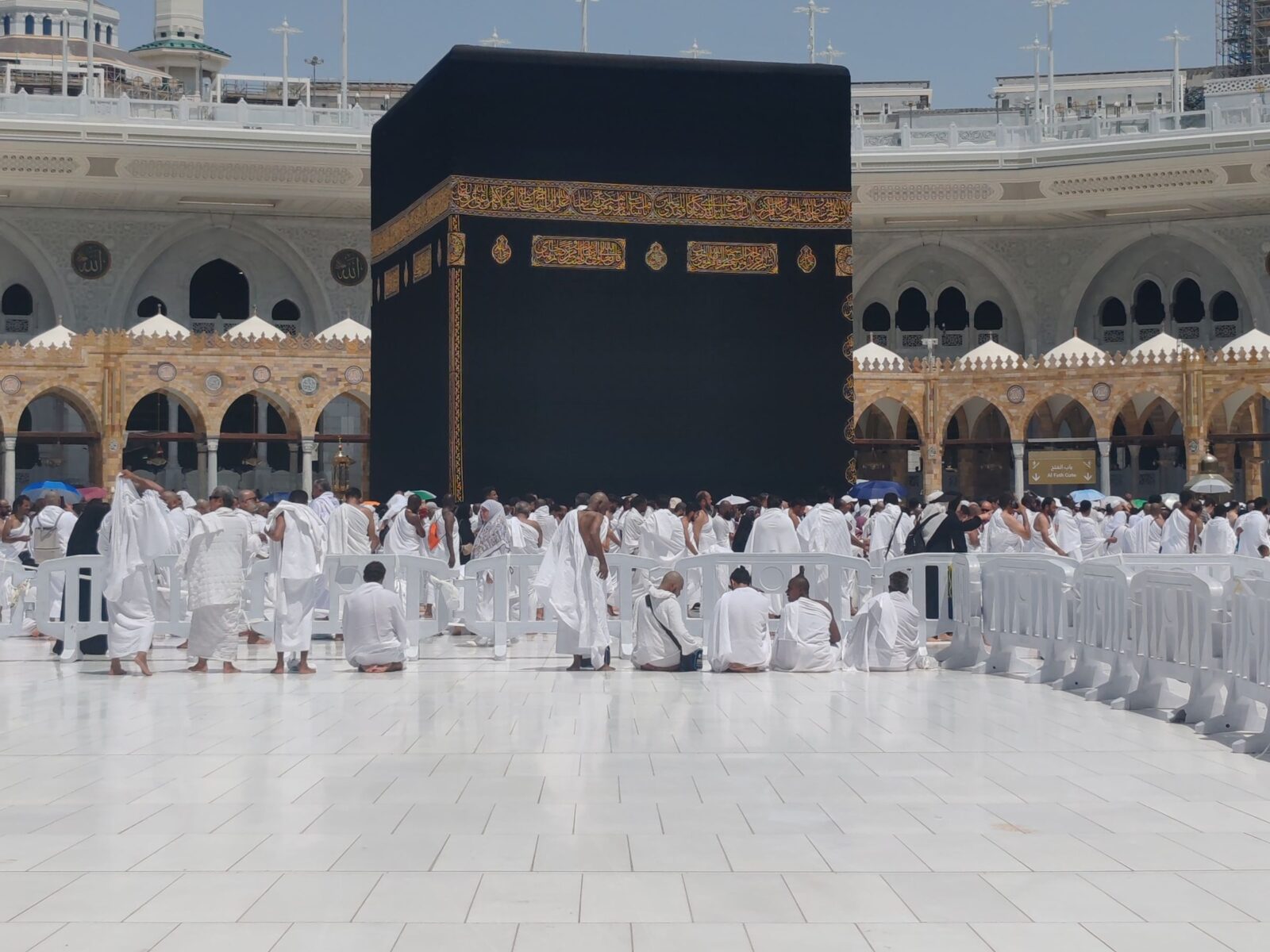
The white stone paving the open courtyards of Masjid al-Haram in Makkah is Thassos marble, quarried on Thassos, the island our own marble comes from. Saudi Arabia has imported it for the Two Holy Mosques since 1978, and the authorities responsible for those mosques credit the stone itself for a floor that stays walkable barefoot through a Makkah summer.
Skaris Export is one of the companies that supplied marble for this project. It is not the work of a single supplier: several companies provided stone for the Grand Mosque, and we are one of them. The technical points below are drawn from published sources, listed at the end; our other projects are here.
What the stone is
Thassos is a dolomitic white marble from the island of Thassos in the northern Aegean, off Kavala. Saudipedia, the Saudi national reference work, describes the courtyard stone as “Greek white natural marble” that is specially imported for the Two Holy Mosques. Arab News reports it arrives in Saudi Arabia as large blocks and is sawn and finished in local factories; published accounts put the courtyard paving at around 5 cm thick.
It is worth being precise about which surfaces: Thassos is the stone of the open, sun-exposed courtyards. The interior flooring of the Prophet’s Mosque in Madinah is Italian Carrara, over an area Saudipedia gives as more than 90,000 m².
Why the floor stays cool
The recurring explanation — that chilled water pipes run under the paving — has been dismissed by the General Presidency for the Affairs of the Two Holy Mosques, which told Saudi media that the reason is the type of marble used.
The properties cited in that reporting are three. A near-white surface reflects most of the light falling on it, so the stone has one of the lowest heat absorbances of any marble. Its dolomite-rich crystal structure spreads heat through the slab rather than holding it at the surface. And engineers quoted by Arab News describe the stone taking up moisture through its fine pores overnight and releasing it during the day, which cools the surface as it evaporates.
The paving has also been studied properly: a 2021 paper in Construction and Building Materials, “Cool white marble pavement thermophysical assessment at Al Masjid Al-Haram, Makkah City, Saudi Arabia”, assessed it directly. We repeat these explanations as published. We have not measured the floor ourselves.
What it tells a specifier
For anyone specifying white marble for an exterior paving, this is a useful reference point for a plain reason: it is a very long service record in a very hard place. Continuous foot traffic, direct sun in one of the hottest inhabited climates on earth, decades in service, under maintenance regimes that would show up a weak stone quickly.
It is also worth saying what the example does not prove. The behaviour at Makkah is the stone plus the build-up beneath it plus the climate — insulating layers, ventilated voids and open-courtyard airflow all contribute. A thick white dolomitic marble will run cooler than a dark stone anywhere, but a surface temperature measured in Makkah is not a number to transfer unchanged to another project. If thermal performance is part of your brief, it belongs in the build-up detail as much as in the stone selection.
If you are specifying Thassos
We supply Thassos in the grades and formats used for flooring, cladding and paving, including thick exterior slabs. Send the dimensions, finish and quantity your project needs and we will come back with the grades available and a price.
Sources
- Arab News, Why the marble flooring of Saudi Arabia’s Two Holy Mosques remains cool even in summer
- Al Arabiya English, Why Mecca’s marble flooring’s cool to touch
- Saudipedia, What keeps the marble of the Two Holy Mosques cool
- Cool white marble pavement thermophysical assessment at Al Masjid Al-Haram, Makkah City, Saudi Arabia, Construction and Building Materials, 2021
- Photograph: Ahmad Khan, via Pexels